Chapter 5: Magic of Faerûn
Source: Forgotten Realms: Heroes of Faerûn
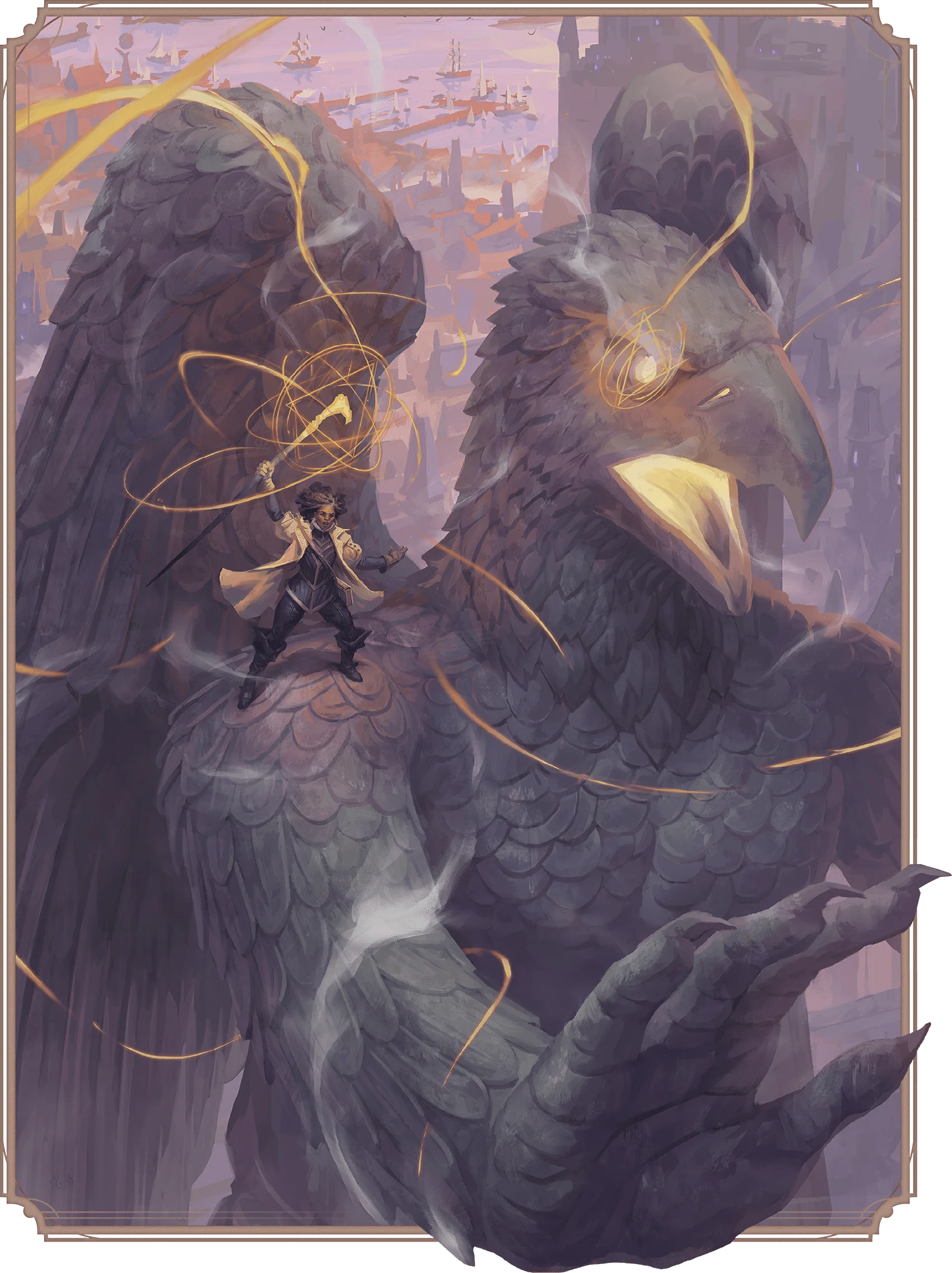
From the simplest cantrip to the mightiest workings of high magic, from a humble Cure Wounds spell to the raising of mighty heroes from the dead, magic permeates the Realms. And any understanding of magic in Faerûn begins with understanding the Weave.
The Weave
The Weave is the raw material from which the tapestry of magic is woven—an essential element of the universe that flows through all things. Some creatures, objects, and locations have especially deep connections to the Weave. Such creatures can perform extraordinary feats that come naturally to them (a beholder’s flight, a vampire’s charming gaze, a dragon’s breath weapon, and so forth), while individuals with the necessary talent and skill can cast spells by manipulating the Weave. The Weave isn’t normally visible or detectable, except through the use of spells.
The god Mystra is the Weave’s keeper and caretaker. All three times the god of magic died or was separated from her divinity (twice as Mystra, and once as her predecessor, Mystryl), magic was twisted or failed entirely. With Mystra’s most recent death and the arrival of the Spellplague, the Weave was thought to be destroyed. But in the Second Sundering, both Mystra and the Weave returned, and spells and magic items became reliable once more.
Magic Items
While a spell is brought to life by manipulating threads of the Weave, the creation of a magic item ties those threads together. The Weave enables individuals to call forth the energy inside a magic item. When a creature attunes to a magic item, threads of the Weave from both wielder and magic item become entwined.
Spellfire
Spellfire is the raw energy of the Weave. The ability to refine and control it is a gift bestowed on a handful of people every generation. Spellfire can manifest as a font of silver light or healing energy, it can absorb magic, or it can be a searing blue-white jet of all-consuming radiance.
The most powerful and direct form of spellfire is spellfire sorcery. But characters of any class can display a connection to spellfire by taking the Spellfire Spark and Spellfire Adept feats. See “chapter 1” for more on these feats and the Spellfire Sorcery subclass.
Weave-Affecting Magic
The rules for spells and spellcasting found in the “Player’s Handbook” are true in Faerûn, but some spells and magical effects might interact in unique ways with the Weave.
Detect Magic. The Detect Magic spell reveals threads of the Weave woven together through spellcasting, and the way the threads are arranged reveals the school of magic. Similarly, active spells and areas imbued with magic are limned in a silvery network of threads, which might twist and reknit themselves depending on the magic involved. A magic item appears enmeshed in the silvery-blue threads of the Weave.
Dispel Magic. The Dispel Magic spell unravels woven threads of the Weave.
Antimagic. The Antimagic Field spell unravels magic woven from the Weave. While an otherwise-permanent effect is within an area of antimagic, the knots of the Weave untie, but the threads retie themselves once the magic is outside the antimagic effect.
Dead Magic. In areas of dead magic, the Weave is absent. Not only do spells and magic items cease to function, but even the supernatural abilities of creatures that are innately tied to the Weave might fail as the knot of the Weave they carry with them unravels.
Wild Magic. In an area of wild magic, the Weave becomes tangled, spontaneously forming its own magic. It also twists the magical creations of the Weave, causing unexpected results.
Wild Magic and Dead Magic
In some parts of Faerûn, the Weave is so warped or frayed that magic doesn’t function reliably, resulting in a wild magic zone. This damage might be due to magical disasters—such as those created during the Time of Troubles, the Spellplague, and the Second Sundering—or a powerful effect that distorts the Weave, such as a mythal. Wild magic zones usually go unnoticed until they make some spell effect go awry. Some mages establish strongholds near wild magic zones. They chart the boundaries of the wild magic zone, lure enemies into it, and then take advantage of their foes’ confusion and weakness.
In other parts of Faerûn, however, the Weave has a tear or hole, resulting in a dead magic zone. Many were created where extreme concentrations of magical power were abruptly shattered or destroyed. The ruins of Myth Drannor, for example, boast large dead magic zones. Dead magic zones also might manifest at locations where Artifacts are destroyed or gods are slain, ripping a hole into the Weave.
The rules for dead magic and wild magic zones are in chapter 3 of the “Dungeon Master’s Guide”.
High Magic
In Faerûn’s early ages, the Weave hadn’t yet stabilized. Elf mages at that time developed a spellcasting system called high magic. This system required many—sometimes hundreds—of spellcasters working in concert, and a single magical effect could take days or weeks to complete. But high magic was capable of incredible feats beyond the reach of ordinary spellcasters today. Elf high mages could heal hundreds of people at once, simultaneously create multiple magic items, restore large portions of forest, or destroy an entire city. The most famous examples of high magic are the raising of the island of Evermeet from the sea and the creation of mythals.
For ages, high magic was thought lost, its techniques supplanted by traditional spellcasting as the Weave settled into its current form. But some secrets of high magic have been preserved, though few living spellcasters retain this knowledge.
Examples of high magic can be found in “chapter 1” of “Forgotten Realms: Adventures in Faerûn”.
Mythals
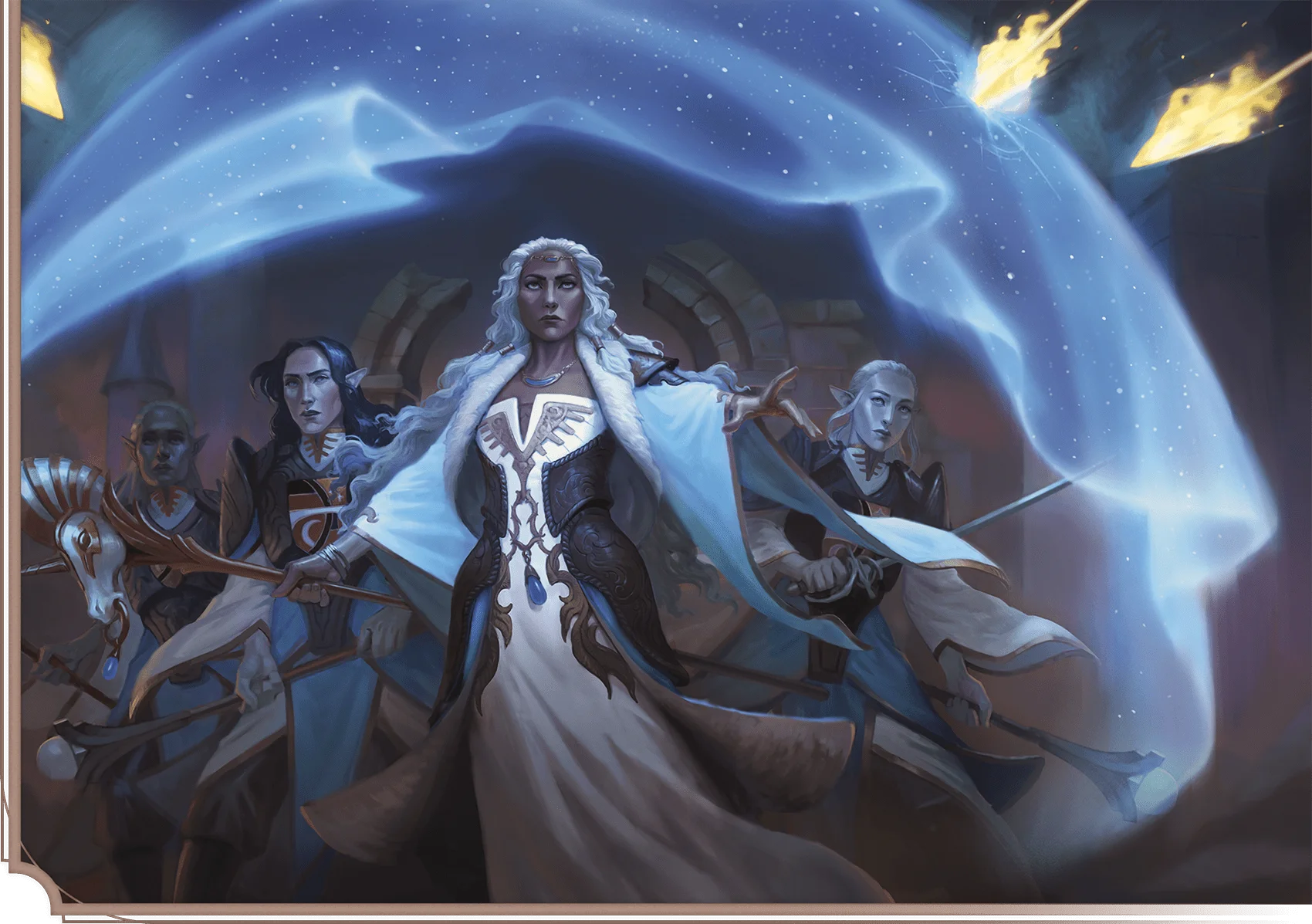
Mythals are some of the most powerful magic in Faerûn. These creations are permanent fields of overlapping magical wards that bind and shape the Weave in a particular location. Mythals are sometimes so powerful that they bend or rewrite the rules of magic or even reality.
In its original usage, the term “mythal” referred to works of high magic that protected ancient elven cities, such as Myth Drannor. Its meaning has since expanded to cover all manner of similar protections, such as the magic keeping the immense floating cities of fallen Netheril afloat, the wards of Silverymoon, and the smaller workings of magic that keep safe important locations like Candlekeep. Some even consider the many-layered wards and effects of Undermountain beneath Waterdeep a mythal.
Most mythals restrict the kinds of magic that can be employed in the area they govern; for example, a mythal might restrict teleportation magic or spells of the Conjuration school. Evereska’s mythal influences the area’s weather and wards its inhabitants against disease, while the mythal of undersea Myth Nantar makes its waters breathable and more comfortable for creatures not suited to underwater life.
In many ways, a mythal is less like a spell or a magic item than a living creation of magic, capable of growing stronger or weaker, absorbing damage, or dying. Mythals can sometimes heal themselves, as did the mythal of Silverymoon, blossoming out of the Moonbridge following Mystra’s most recent return.
Each active mythal has one or more individuals especially attuned to it, and these individuals can ignore any restrictions on spellcasting, direct targetable effects of the mythal, and teach others of appropriate skill how to access its secrets.
Adventurers are most likely to encounter damaged or failing mythals in ruined locations where magic once had great influence. Although an Identify spell might reveal some of a mythal’s simplest effects, spellcasters can discover spellcasting restrictions only by trying (and failing) to cast a prohibited spell. A powerful spellcaster might learn how to access or repair a mythal without assistance, but such feats are rarely attempted by even the most renowned mages. Any elven city with “Myth” in its name (Myth Drannor, Myth Glaurach, Myth Nantar, and others) has or had a mythal. The ruins of such places often exhibit unpredictable effects related to their damaged or destroyed mythals.
Circle Magic
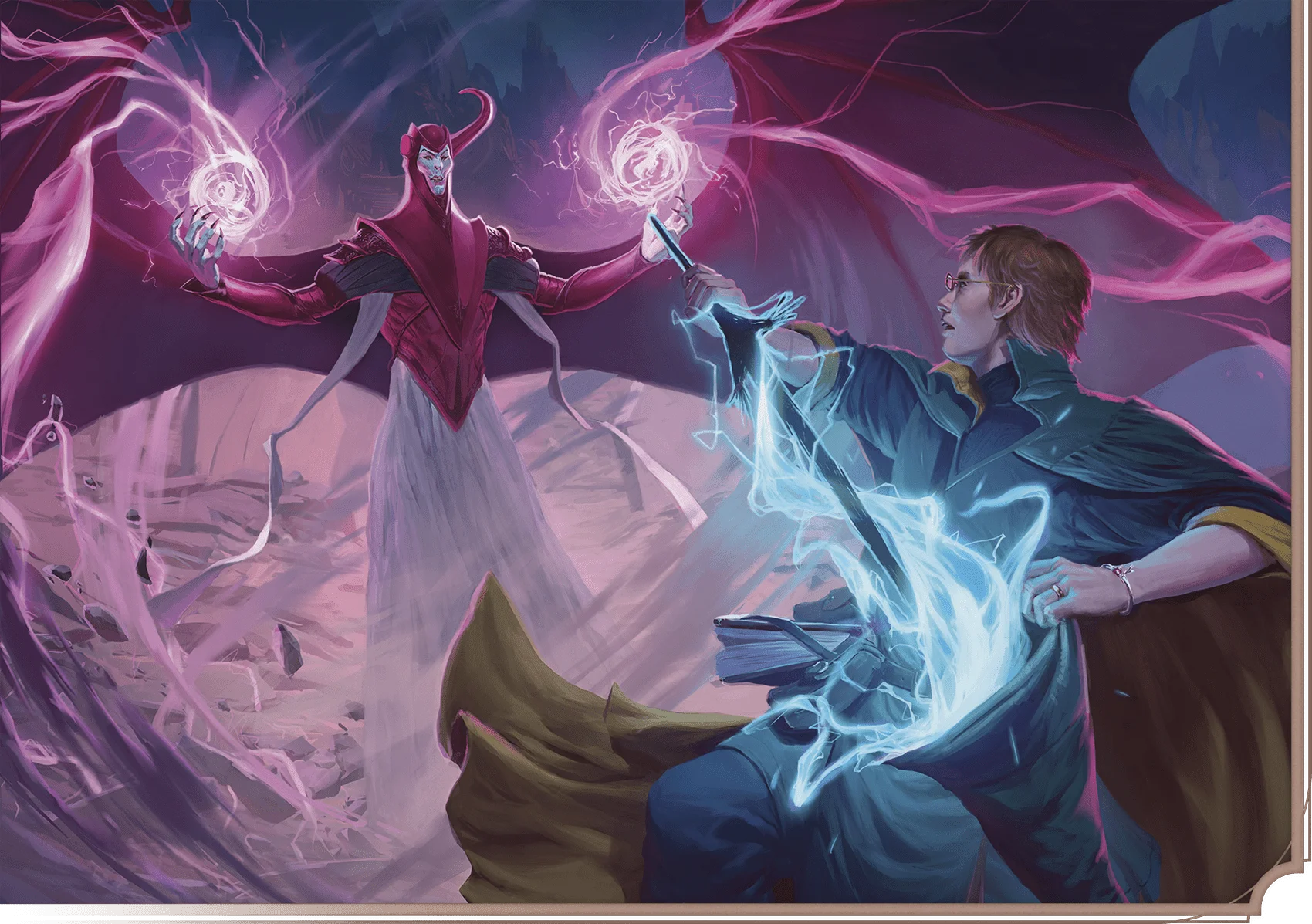
Millennia ago, elf mages researching alternative magical traditions developed a technique by which many spellcasters working together could cast spells beyond the limit of any individual. This technique became known as circle magic, and although it was initially developed by elves, spellcasters in Thay and Rashemen reinvented the technique, and from there it quickly spread to other realms in Faerûn.
What Is a Circle Spell?
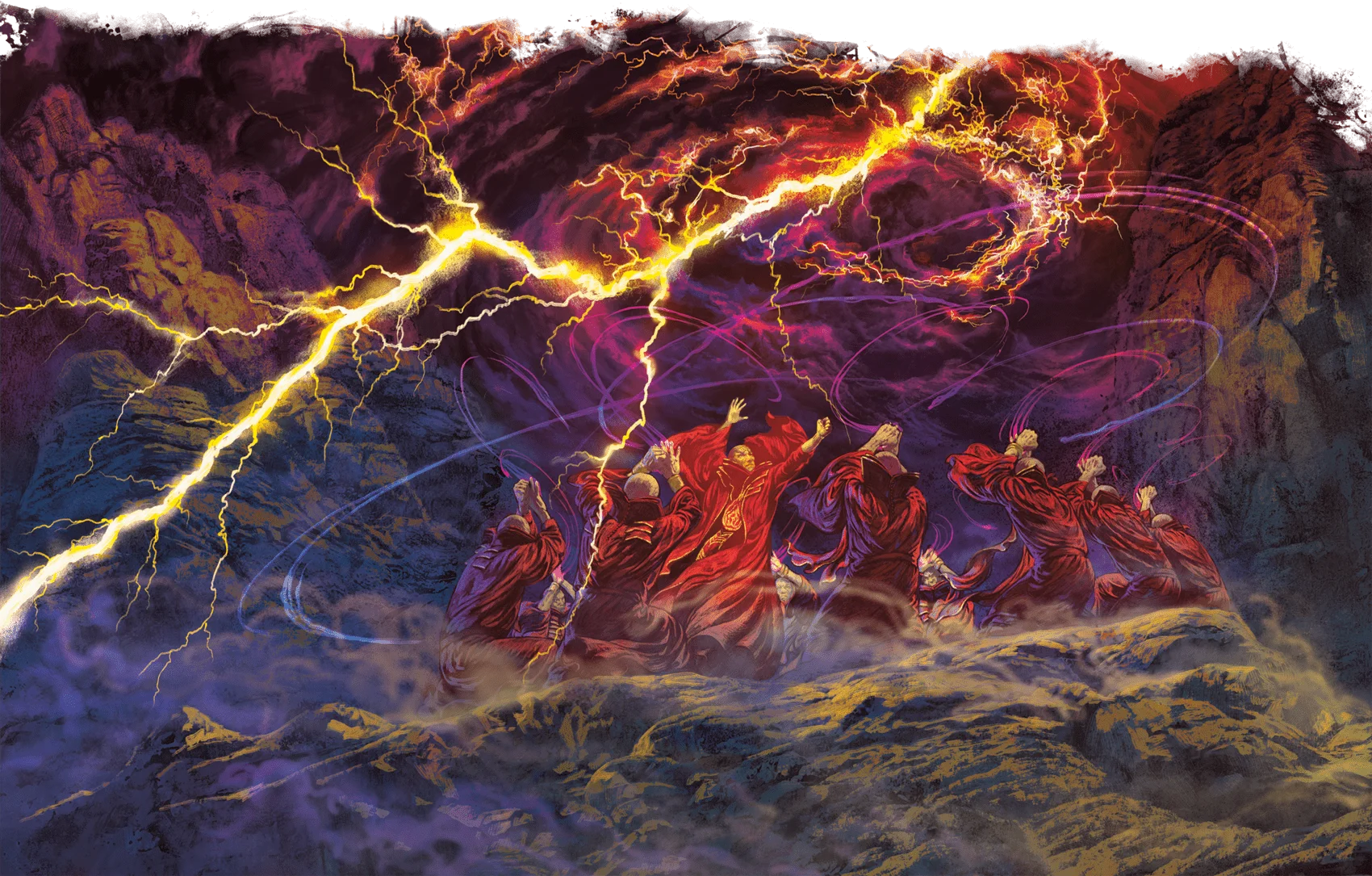
When a group of spellcasters collectively channel their magic into a single spell, they can enhance and augment the spell’s magic in powerful ways. A spell cast in this way is known as a Circle spell.
Eligible Spells
Any spell that has a casting time of an action or 1 minute or longer and is cast using a spell slot can be cast as a Circle spell. To cast a Circle spell, follow the usual rules for spellcasting, as described in the “Player’s Handbook”, as well as the following rules for Circle spells.
Casting a Circle Spell
A Circle spell has one primary caster (“you” in these rules). Unless otherwise specified, you as the primary caster decide the spell’s targets, maintain Concentration if required by the spell’s Duration entry, provide the spell’s components, expend the slot for casting the spell, and decide any of the other options noted in the spell’s description. The spell’s effects originate from you.
Initiating a Circle Spell
You take a Magic action to initiate casting a Circle spell. When you do so, choose which Circle casting option (see “Circle Casting Options” below) you’re using for this casting; you must also meet any of the other requirements described in that option’s text. Until the Circle spell’s casting is complete (see below), you must maintain Concentration on the spell.
If a Reaction would trigger when a creature casts a spell—such as the Reaction taken to cast Counterspell—it also triggers when you take this action to initiate a Circle spell.
Secondary Casters
Casting a Circle spell requires that one or more other spellcasters, called secondary casters, lend their magic to the spell. A secondary caster must have either the Spellcasting or Pact Magic feature to participate in a Circle spell.
After you initiate the spell, each secondary caster takes the Magic action to contribute to the spell. A secondary caster can take this action only while within 30 feet of you and before the start of your next turn.
Completing the Casting
If the spell has a casting time of an action, the Circle spell’s effects occur immediately after the final secondary caster takes the required action to contribute to the spell. You decide which secondary caster is the final one.
If the spell has a casting time of 1 minute or more, you and each secondary caster must take the Magic action on each of your turns for the entire casting time, and you must each maintain Concentration while you do so. In this case, if any caster’s Concentration is broken, the spell fails.
NPC Secondary Casters
Some Circle spells require secondary casters to expend one or more spell slots to participate in the spell’s casting. At the DM’s discretion, NPCs capable of casting spells—such as spellcasters hired in settlements—can meet this requirement by expending one or more limited uses of any spells of the same level or higher in place of the required spell slots.
Spell Failure
If a Circle spell fails, nothing happens. You don’t expend a spell slot, and any Material components aren’t consumed. To cast the spell again, you must start over.
Circle Casting Options
The following options provide ways to enhance a spell when casting it as a Circle spell. You can use only one Circle casting option on a spell at a time.
Some spells have a “Casting as a Circle Spell” section in their description. Instead of using one of the following options, you can create the effect described in that section when casting the spell as a Circle spell. Such effects are often uniquely powerful and specific to their respective spells.
Augment
When you cast a spell with a range of at least 5 feet, you can increase the range of the spell by 1,000 feet per secondary caster contributing to the spell, up to a maximum of a 1-mile increase.
Distribute
When you cast a spell that requires Concentration, you can distribute the mental load of the spell among you and the secondary casters. Once the casting is complete, you and all secondary casters can maintain Concentration on this spell. As long as at least one caster who contributed to the spell maintains this Concentration, the spell’s effects remain active.
Expand
When you cast a spell that creates an area of effect, you can increase one dimension of the spell’s area of effect for this casting by 10 feet per secondary caster contributing to the spell. For example, if a spell creates a 20-foot-radius Sphere, casting it as a Circle spell with two secondary casters would increase the radius to 40 feet. A spell that creates a Line that is 5 feet wide and 300 feet long, cast as a Circle spell with two secondary casters, could make a Line that is either 25 feet wide or 320 feet long.
Each secondary caster contributing to the spell must expend a spell slot (no action required). If the spell fails, these spell slots aren’t expended.
Prolong
When you cast a spell that has a duration of 1 minute or longer, you can increase the duration of the spell depending on the number of secondary casters contributing to the spell, as detailed in the table below.
Each secondary caster contributing to the spell must expend a spell slot (no action required). If the spell fails, these spell slots aren’t expended.
| Secondary Casters | The Spell Increases Duration By… |
|---|---|
| 1–3 | 1 hour |
| 4–6 | 8 hours |
| 7+ | 24 hours |
| ^secondary-casters-the-spell-increases-duration-by |
Safeguard
When you cast a spell that creates an area of effect, you can carve out a safe zone within that area of effect that is unaffected by the spell for its duration. This safe zone consists of a number of 5-foot Cubes equal to your spellcasting ability modifier plus the number of secondary casters contributing to the spell (minimum of one Cube). You can arrange the Cubes as you like, but each Cube must be contiguous with at least one other Cube.
If the spell’s area of effect can be moved, the safe zone moves with it.
Supplant
When you cast a spell that requires at least one Material component with a specified cost that is consumed by the spell, you can reduce the minimum cost of one such Material component by 50 GP per each secondary caster contributing to the spell. For example, casting Revivify as a Circle spell with two secondary casters would reduce the Material component’s minimum cost to 200 GP.
Each secondary caster contributing to the spell must expend a spell slot of a level greater than or equal to the spell’s level (no action required). If the spell fails, these spell slots aren’t expended.
Circle Magic in the Game
Circle magic provides unique and strategic ways of altering spellcasting. Here are some general guidelines for implementing circle magic in your game.
Character Level and Experience. Though characters of any level can use circle magic, characters with access to higher-level spells have more avenues to make the most of circle magic.
Know Your Spells. Casting a Circle spell benefits from a solid understanding of how regular spellcasting works. Be sure to study your prepared spells and Circle casting options before the game. Many Circle casting options provide the most benefits to spellcasting when used outside of combat!
Plan Ahead. Circle magic functions best when participants strategize ahead of time. To avoid bogging down combat, work together with fellow spellcasters to determine how and when to cast a Circle spell. Additionally, ensure all participants still have ample opportunity to cast spells and act independently beyond contributing to circle magic.
Spells
The following spells are presented in alphabetical order.
- Alustriel’s Mooncloak
- Backlash
- Blade of Disaster
- Cacophonic Shield
- Conjure Constructs
- Death Armor
- Deryan’s Helpful Homunculi
- Dirge
- Doomtide
- Elminster’s Effulgent Spheres
- Elminster’s Elusion
- Holy Star of Mystra
- Laeral’s Silver Lance
- Simbul’s Synostodweomer
- Songal’s Elemental Suffusion
- Spellfire Flare
- Spellfire Storm
- Syluné’s Viper
- Wardaway