Chapter 7: Treasure
Source: Dungeon Master’s Guide (2024), p. 213
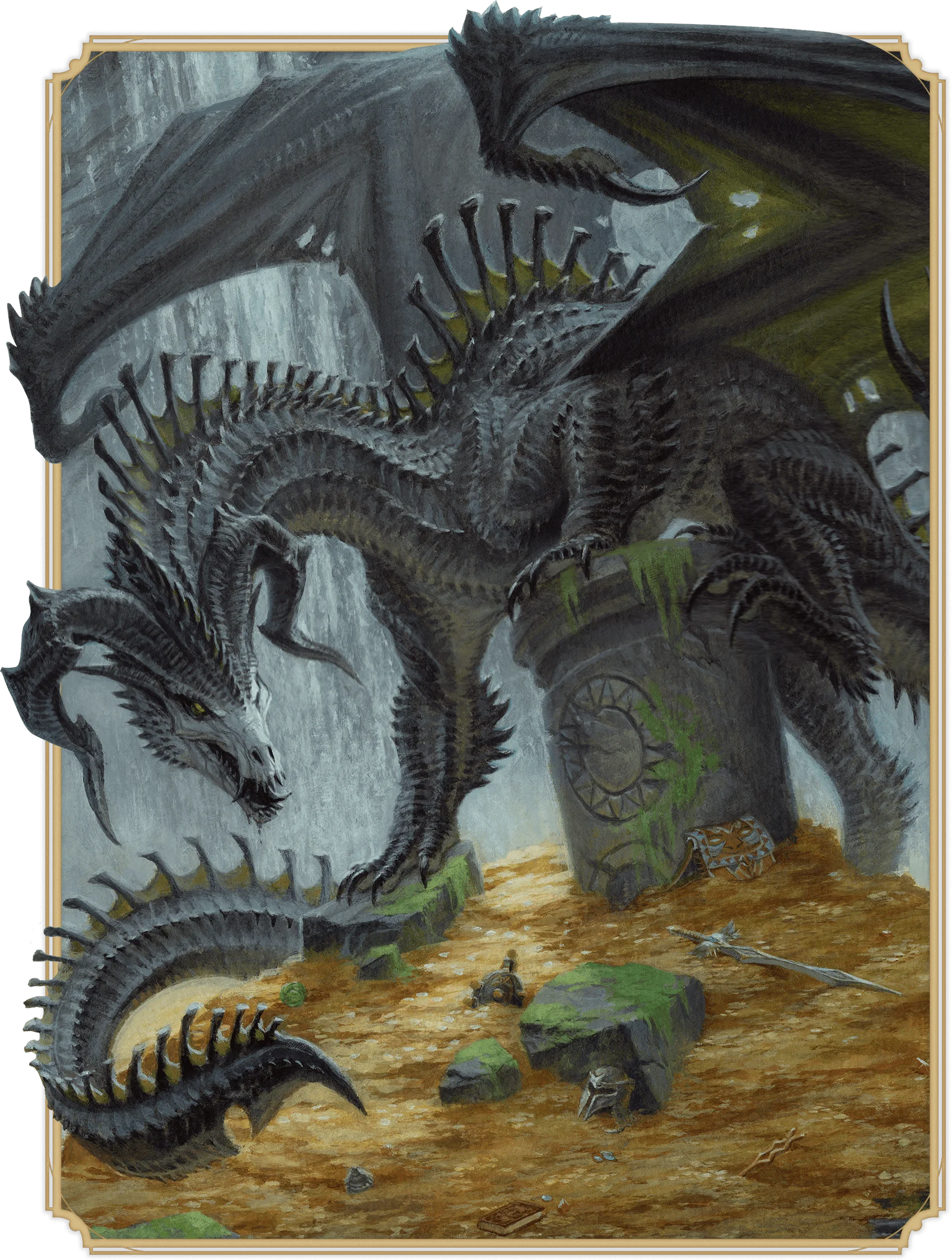
Adventurers strive for many things, including glory, knowledge, and justice. Many adventurers also seek something more tangible: treasure. This chapter presents treasure in all its forms, from coins to magic items.
Treasure Themes
Monsters have treasure preferences, as explained in the “Monster Manual”. These preferences are expressed as themes, which helps you determine what treasures are found in monsters’ hoards, as summarized in the Treasure Themes table.
For advice on how to “include treasure in an adventure”, see “chapter 4”.
To randomly determine a magic item found as treasure, use the “tables” at the end of this chapter.
Coins
The most basic type of treasure is money, including Copper Pieces (CP), Silver Pieces (SP), Electrum Pieces (EP), Gold Pieces (GP), and Platinum Pieces (PP). See the “Player’s Handbook” for their relative value. Fifty coins of any type weigh 1 pound.
Trade Bars
Because large numbers of coins can be difficult to transport and account for, many merchants prefer to use trade bars—ingots of precious metals and alloys (usually silver). These bars are valued by weight, as shown in the Trade Bars table.
Trade Goods
Merchants commonly exchange trade goods without using currency. The Trade Goods table shows the value of commonly exchanged goods.
Gemstones
Gemstones are small, lightweight, and easily secured compared to their same value in coins.
If a treasure hoard includes gemstones, you can use the following tables to randomly determine the kind of gemstones found, based on their value. You can roll once and assume all the gems are the same or roll multiple times to create mixed collections.
Art Objects
Idols cast of solid gold, necklaces studded with precious stones, paintings of ancient kings, bejeweled dishes—art objects include all these and more.
If a treasure hoard includes art objects, you can use the following tables to randomly determine what art objects are found, based on their value. Roll on a table as many times as there are art objects in the treasure hoard. There can be more than one of a given art object.
Magic Items
Magic items are gleaned from the hoards of felled monsters or discovered in long-lost vaults. Such items grant capabilities a character could rarely have otherwise, or they complement their owner’s capabilities in wondrous ways.
Magic Item Rules
Rules for “identifying”, “attuning to”, and “using” magic items appear in the “Player’s Handbook”. Additional rules are presented below.
Attunement Prerequisites. If a magic item has a class prerequisite, a creature must be a member of that class to attune to the item. If a creature must be a spellcaster to attune to an item, the creature qualifies if it can cast at least one spell using its traits or features, not by using a magic item or the like.
Items Made for Specific Creatures. Magic items that are meant to be worn tend to magically adjust themselves to the wearer. However, you can decide that a magic item doesn’t adjust its size to fit any wearer. For example, a particular armorer might make items usable only by folk who are sized and shaped like dwarves.
Unusual Anatomy. Use your discretion to decide whether a creature can wear an item not made for its anatomy. A ring placed on a tentacle might work, but a yuan-ti with a snakelike tail instead of legs can’t wear magic boots.
Paired Items. You can allow exceptions to the rule that paired items must both be worn. For example, a character with only one arm might be able to use a single Glove of Missile Snaring so long as the matching glove is on their person.
Magic Item Categories
Every magic item belongs to a category. The Magic Item Categories table lists the nine categories and provides examples. Rules for the categories appear after the table.
Armor
An item in the Armor category is typically a magical version of armor from the “Player’s Handbook”. Unless an armor’s description notes otherwise, the armor must be worn for its magic to function.
Some suits of magic armor specify the type of armor they are, such as Chain Mail or Plate Armor. If no type is specified, choose the type or determine it randomly.
Potions
An item in the Potion category might be a magical brew that must be imbibed or an oil that must be applied to a creature or an object. A typical potion consists of 1 ounce of liquid in a vial.
Using a Potion
Potions are consumable items. Drinking a potion or administering it to another creature requires a Bonus Action. Applying an oil might take longer as specified in its description. Once used, a potion takes effect immediately, and it is used up.
Mixing Potions
A character might drink one potion while still under the effects of another or pour several potions into a single container. The strange ingredients used in creating potions can result in unpredictable interactions.
When a character mixes two potions together, roll on the Potion Miscibility table. If more than two are combined, roll again for each subsequent potion, combining the results. Unless the effects are immediately obvious, reveal them only when they become evident.
Rings
For its magic to function, an item in the Ring category must be worn on a finger or a similar digit unless its description notes otherwise.
Rods
An item in the Rod category is a scepter usually made of metal, wood, or bone. A typical rod weighs 2 to 5 pounds.
Unless its description notes otherwise, a rod can be used as an Arcane Focus.
Scrolls
An item in the Scroll category is a roll of paper or parchment, sometimes attached to wooden rods and typically kept safe in a tube of ivory, jade, leather, metal, or wood. The most prevalent scroll is the Spell Scroll, a spell stored in written form. However, some scrolls, like the Scroll of Protection, bear an incantation that isn’t a spell.
Using a Scroll
Scrolls are consumable items. Unleashing the magic in a scroll requires the user to read the scroll. When its magic has been invoked, the scroll can’t be used again. Its words fade, or it crumbles into dust.
Any creature that can understand a written language can read a scroll and attempt to activate it unless its description notes otherwise.
Staffs
Items in the Staff category vary widely in appearance: some are of nearly equal diameter throughout and smooth, others are gnarled and twisted, some are made of wood, and others are composed of polished metal or crystal. A staff weighs between 2 and 7 pounds and serves well as a walking stick or cane.
Unless its description notes otherwise, a staff can be used as a nonmagical Quarterstaff and an Arcane Focus.
Wands
An item in the Wand category is typically 12 to 15 inches long and crafted of metal, bone, or wood. It is tipped with metal, crystal, stone, or some other material.
Unless its description notes otherwise, a wand can be used as an Arcane Focus.
Weapons
A magic weapon is typically a magical version of a weapon from the “Player’s Handbook”. Some magic weapons specify the type of weapon they are in their descriptions, such as a Longsword or Longbow. If no weapon type is specified, you may choose the type or determine it randomly.
Ammunition
If a magic weapon has the Ammunition property, ammunition fired from it is considered magical for the purpose of any rule that cares whether a weapon is magical or not.
Wondrous Items
Wondrous Items include wearable items such as boots, belts, capes, amulets, brooches, and circlets. Bags, carpets, figurines, horns, musical instruments, and more also fall into this category.
Magic Item Rarity
Every magic item has a rarity, which provides a rough measure of an item’s power relative to other magic items. The rarities are shown in the Magic Item Rarities and Values table.
Common magic items, such as a Potion of Healing, are the most plentiful. Artifacts, such as the Wand of Orcus, are priceless, unique, and difficult to acquire.
Magic Item Values by Rarity
Common magic items can often be bought in a town or city. Uncommon and Rare magic items are usually found only in cities, and rarer magic items might be sold only in wondrous locations, such as the “City of Brass” or “Sigil”. If you allow characters to buy and sell magic items in your campaign, rarity can help you set prices for those items. Gold Piece values are provided in the Magic Item Rarities and Values table, though a seller might ask for a service rather than coin as payment.
If a magic item incorporates an item that has a purchase cost in the “Player’s Handbook” (such as a weapon or a suit of armor), add that item’s cost to the magic item’s value. For example, +1 Armor (Plate Armor) has a value of 5,500 GP, which is the sum of a Rare magic item’s value (4,000 GP) and the cost of Plate Armor (1,500 GP).
Awarding Magic Items
Awarding magic items is the purview of the DM. You can award a magic item because the story calls for it or the players would be especially pleased to have it. This section helps you to determine which magic items end up in the characters’ possession.
Are Magic Items Necessary?
The D&D game assumes that magic items appear sporadically and that they are a boon unless an item bears a curse. Characters and monsters are built to face each other without the help of magic items, which means that having a magic item makes a character more powerful or versatile than a generic character of the same level. As DM, you never have to worry about awarding magic items just so the characters can keep up with the campaign’s threats. Magic items are truly prizes—desirable but not necessary.
Magic Items Awarded by Level
The Magic Items Awarded by Level table shows the number of magic items a D&D party typically gains during a campaign, totaling one hundred magic items by level 20. The table shows how many items of each rarity are meant to be handed out during each of the four tiers of play.
Artifacts are omitted from the table because they are most often used as plot devices in high-level adventures, and characters rarely have them for long (either because the Artifacts are meant to be destroyed or because the campaign is nearing its end).
Player Wish List
Encourage your players to keep a wish list of magic items they hope their characters will find in the course of the campaign. If you want to award a magic item but don’t have a specific magic item in mind, you can pick an item of the appropriate rarity from your players’ wish list.
Overstocking an Adventure
When creating or modifying an adventure, assume that the characters won’t find all the magic items you place in it. An adventure usually can include a number of items that’s 25 percent higher than the number in the Magic Items Awarded by Level table (round up). For example, an adventure designed to take characters from level 1 to 4 might include fourteen items rather than eleven, in the expectation that three items won’t be found.
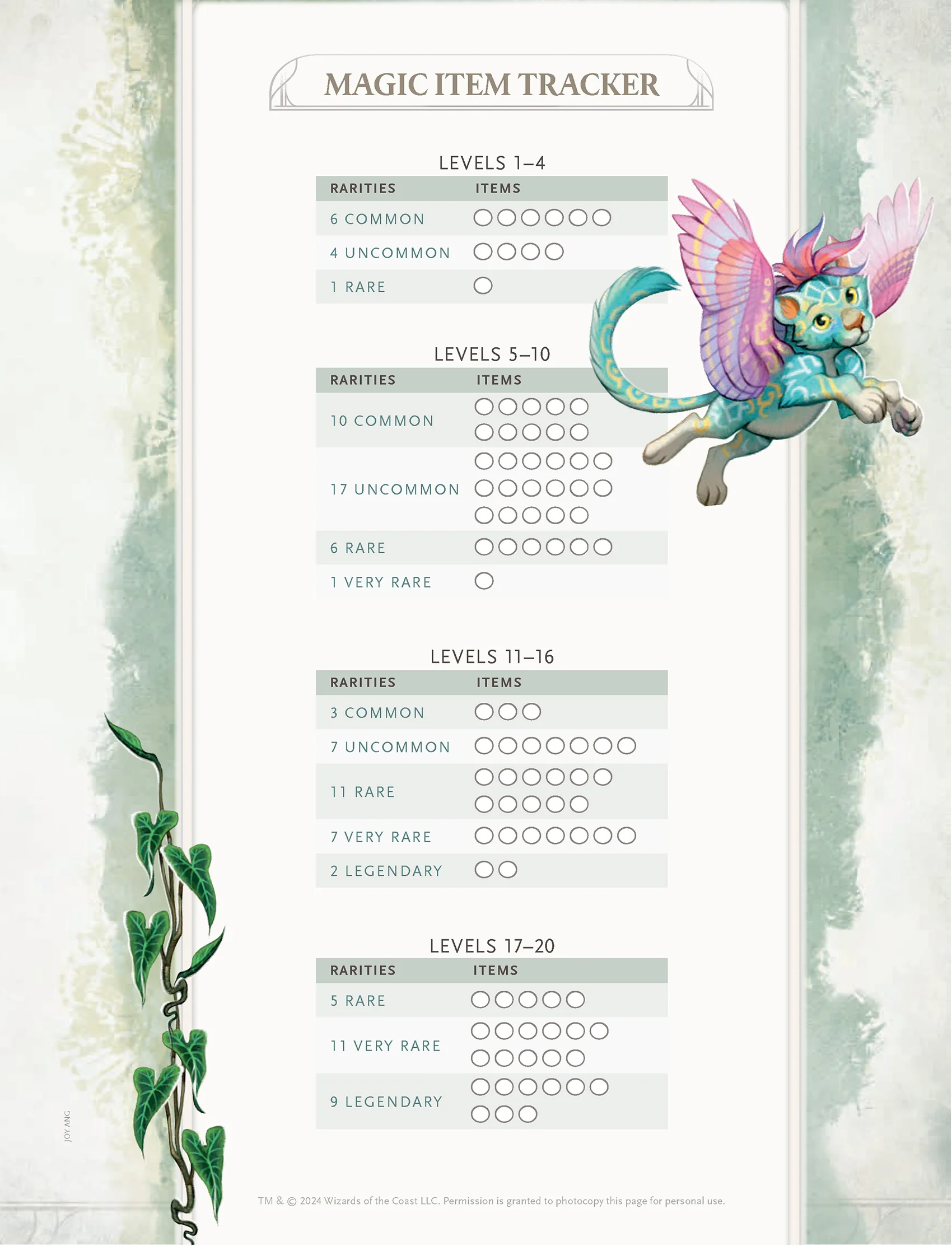
Magic Item Tracker
You can use the Magic Item Tracker sheet to track how many magic items the characters have acquired. Each time the characters get a magic item, put a check mark in one of the empty circles corresponding to the item’s rarity and the current level range of the characters. If the characters gain a magic item of a rarity that has no unchecked circles at the current level range, check off an empty circle from a lower tier. If all lower level ranges also have no circles left, check off an empty circle from a higher level range.
Random Magic Item Rarity
When you decide that a treasure contains magic items, there are two ways to determine the rarity of those items. You can choose an appropriate rarity based on the items you’ve given out already (using the Magic Item Tracker sheet to keep track), or you can roll on the Magic Item Rarities table.
To use the table, find the level of the characters in the top row. Roll 1d100, and read down that column to find your roll. Then read across to the right column to find the rarity of the item.
Magic Items for Starting Characters
If you’re starting a campaign for characters above level 1, the “Player’s Handbook” offers suggestions for how many magic items such characters should start with and the rarity of those items. Consider these approaches to determining the items each character receives:
- DM Choice. Choose items for each character using your own judgment.
- Player Choice. Let the players choose whatever items they want, within the specified rarity.
- Random Determination. Use the tables at the end of this chapter to randomly determine starting items. Use the “Arcana tables” for Sorcerers, Warlocks, and Wizards. Use the “Armaments tables” for Barbarians, Fighters, Paladins, and Rangers. Use the “Implements tables” for Bards, Monks, and Rogues. Use the “Relics tables” for Clerics and Druids. Feel free to vary the tables you use to give each character a mix of useful items and to match character themes. For example, for a Fighter with the Eldritch Knight subclass, you might choose one item from the “Arcana tables” and the rest of the character’s items from the “Armaments tables”.
Activating a Magic Item
It usually takes a Magic action to activate a magic item. The item’s user might also need to do something special. The description of each item category or individual item details how an item is activated. Certain items use the following rules for their activation.
Command Word
A command word is a word or short phrase that must be spoken or signed for an item to work. Spoken command words must be audible and fail to work in areas where all sound is suppressed, as in the area of the Silence spell.
Consumable Items
Some items are consumed—used up, in other words—when they are activated. A Potion of Healing must be swallowed, for example, while the writing vanishes from a scroll when it is read. Once used, a consumable item loses its magic.
Spells Cast from Items
Some magic items allow the user to cast a spell from the item. The spell is cast at the lowest possible spell and caster level, doesn’t expend any of the user’s spell slots, and requires no components unless the item’s description notes otherwise. The spell uses its normal casting time, range, and duration, and the user of the item must concentrate if the spell requires Concentration. Many items, such as Potions, bypass the casting of a spell and confer the spell’s effects with its usual duration. Certain items make exceptions to these rules, changing the casting time, duration, or other parts of a spell.
A magic item may require the user to use their own spellcasting ability when casting a spell from the item. If the user has more than one spellcasting ability, the user chooses which one to use with the item. If the user doesn’t have a spellcasting ability, their spellcasting ability modifier is +0 for the item, and the user’s Proficiency Bonus applies.
Charges
Some magic items have charges that must be expended to activate their properties. The number of charges an item has remaining is revealed when the Identify spell is cast on it. A creature attuned to an item knows how many charges the item has and how many it regains.
”The Next Dawn”
Magic items often have charges or properties that recharge at the next dawn or some other specified time. If such an item is on a world or plane of existence where the specified event doesn’t occur, the DM determines when the item recharges.
Cursed Items
A magic item’s description specifies whether it bears a curse. Most methods of identifying items, including the Identify spell, fail to reveal such a curse.
Attunement to a cursed item can’t be ended voluntarily unless the curse is broken first, such as with a Remove Curse spell.
Magic Item Resilience
A magic item is at least as durable as a nonmagical item of its kind. Most magic items, other than Potions and Scrolls, have Resistance to all damage.
An Artifact can be destroyed only in some special way. Otherwise, it is impervious to damage. Learning how to destroy an Artifact usually requires research or the completion of a quest.
Crafting Magic Items
The “Player’s Handbook” contains rules on “brewing Potions of Healing” and “scribing Spell Spell Scrolls”. To create other magic items, follow the rules below. In these rules, “you” refers to the character crafting the magic item.
Arcana Proficiency
To craft a magic item, you and any assistants must have proficiency in the Arcana skill.
Tools
The Magic Item Tools table lists which tool is required to make a magic item of each category. You must use the required tool to make an item and have proficiency with that tool. Any assistants must also have proficiency with it. For more “information on the tools”, see the “Player’s Handbook”.
Spells
If a magic item allows its user to cast any spells from it, you must have all those spells prepared every day you spend crafting the item.
Time and Cost
Crafting a magic item takes an amount of time and money based on the item’s rarity as shown in the Magic Item Crafting Time and Cost table.
Work per Day
For each day of crafting, you must work for 8 hours. If an item requires multiple days, those days needn’t be consecutive.
Assistants
Characters can combine their efforts to shorten the crafting time. Divide the time needed to create an item by the number of characters working on it. Normally, only one other character can assist you, but the DM might allow more assistants.
Raw Materials
The cost in the table represents the raw materials needed to make a magic item. The DM determines whether appropriate raw materials are available. In a city, there is a 75 percent chance that the materials are available, and in any other settlement, that chance is 25 percent. If materials aren’t available, you must wait at least 7 days before checking on the availability again.
If a magic item incorporates an item that has a purchase cost (such as a weapon or a suit of armor), you must also pay that entire cost or craft that item “using the rules” in the “Player’s Handbook”. For example, to make +1 Armor (Plate Armor), you must pay 3,500 GP or pay 2,000 GP and craft the armor.

Magic Item Special Features
You can add distinctiveness to a magic item by thinking about its backstory. Who made the item? Is anything unusual about its construction? Why was it made, and how was it used originally? What minor magical quirks set it apart from other items of its kind? Answering these questions can help turn a generic magic item, such as a +1 Longsword, into a more flavorful discovery.
Use the following tables to fill in details about a magic item’s history. Some table entries make more sense for certain items than for others. If you roll something that doesn’t make sense, roll again, choose a more appropriate entry, or use the rolled detail as inspiration to make up your own special feature.
On the Magic Item’s Minor Property table and the Magic Item’s Quirk table, “you” refers to the item’s bearer.
Artifacts
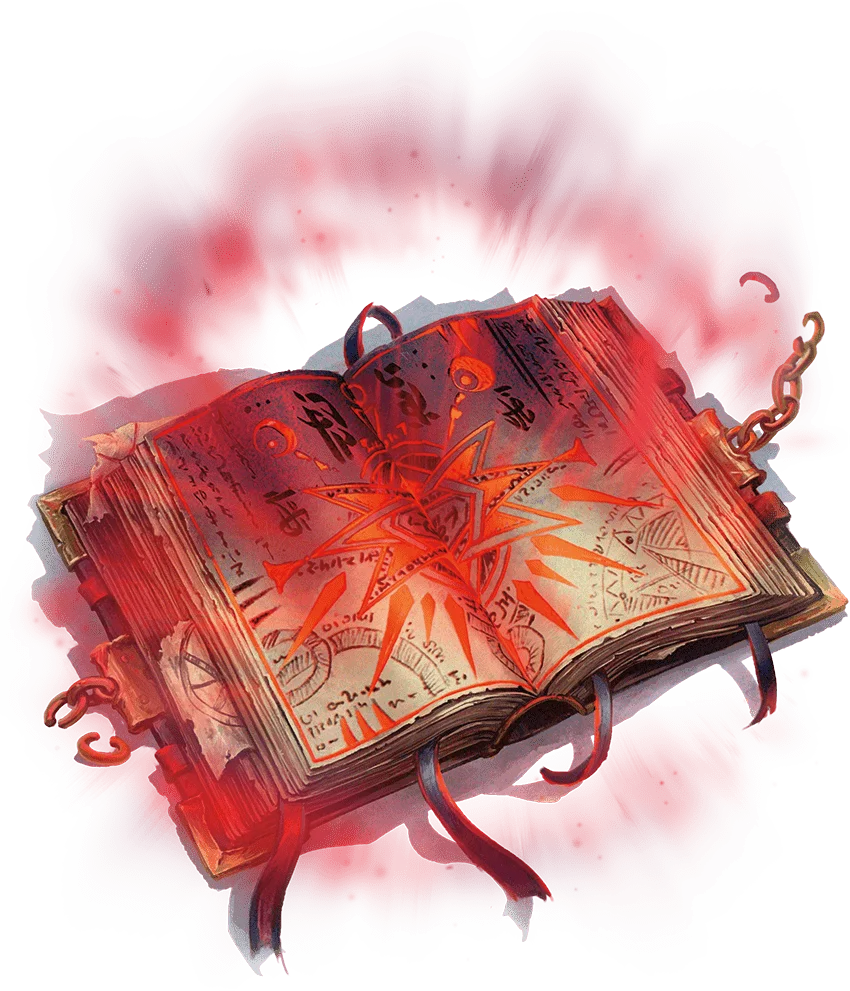
An Artifact is a unique, singularly powerful magic item with its own origin and history. It could have been created in the midst of a crisis that threatened a kingdom, a world, or the entire multiverse, and carry the weight of that pivotal moment in history.
Some Artifacts appear when they are needed most. For others, the reverse is true; when these Artifacts are discovered, the world trembles at the ramifications of the find. In either case, introducing an Artifact into a campaign requires forethought. It could be an item that opposing sides are hoping to claim, or it might be something the adventurers need to overcome their greatest challenge.
Characters don’t typically find Artifacts in the normal course of adventuring. In fact, Artifacts appear only when you want them to, for they are as much plot devices as magic items. Tracking down and recovering an Artifact is often the main goal of an adventure. Characters must chase down rumors, undergo significant trials, and venture into dangerous, half-forgotten places to find the Artifact they seek. Alternatively, a major villain might already have the Artifact. Obtaining and destroying the Artifact could be the only way to ensure that its power can’t be used for evil.
Artifact Properties
In addition to its defined properties, an Artifact might have other properties that are either beneficial or detrimental. You can choose such properties from the tables in this section or determine them randomly. You can also invent new beneficial and detrimental properties. These properties typically change each time an Artifact appears in the world.
An Artifact can have as many as four minor beneficial properties and two major beneficial properties. It can have as many as four minor detrimental properties and two major detrimental properties.
Sentient Magic Items
Some magic items have sentience and personality. Such an item might be possessed, haunted by the spirit of a previous owner, or self-aware thanks to the magic used to create it. A sentient item might be a cherished ally to its wielder or a continual thorn in the side.
Most sentient items are weapons, but other kinds of items can manifest sentience. Single-use items such as potions and scrolls are never sentient.
The DM controls sentient magic items and their activated properties. A bearer who maintains a good relationship with the item can access those properties. If the relationship is strained, a conflict can ensue (see ""Conflict"" below).
Sentient Magic Item Traits
When you make a sentient magic item, you create the item’s persona much as you would create an NPC (as described in the ""Nonplayer Characters"" section of “chapter 3”), with these exceptions.
Abilities
A sentient magic item has Intelligence, Wisdom, and Charisma scores. Choose the item’s abilities, or determine them randomly as follows: roll 4d6 for each one, dropping the lowest roll and totaling the rest.
Alignment
A sentient magic item has an alignment. Its creator or nature might suggest an alignment. Otherwise, pick an alignment or roll on the Sentient Item’s Alignment table.
Communication
A sentient item communicates by sharing its emotions, broadcasting its thoughts telepathically, or speaking aloud. You can choose how it communicates or roll on the Sentient Item’s Communication table.
Senses
A sentient item can perceive its surroundings out to a limited range. You can choose its senses or roll on the Sentient Item’s Senses table.
Special Purpose
You can give a sentient item an objective it pursues, perhaps to the exclusion of all else. As long as the wielder’s use of the item aligns with that special purpose, the item remains cooperative. Deviating from this course might cause conflict between the wielder and the item (see ""Conflict"" below). You can pick a special purpose or roll on the Sentient Item’s Special Purpose table.
Conflict
When the bearer of a sentient item acts in a manner opposed to the item’s alignment or purpose, conflict can arise. When such a conflict occurs, the item’s bearer makes a Charisma saving throw (DC 12 plus the item’s Charisma modifier). On a failed save, the item makes one or more of the following demands:
- Chase My Dreams. The item demands that its bearer pursue the item’s goals to the exclusion of all other goals.
- Get Rid of It. The item demands that its bearer dispose of anything the item finds repugnant.
- It’s Time for a Change. The item demands to be given to someone else.
- Keep Me Close. The item insists on being carried or worn at all times.
If its bearer refuses to comply with the item’s demands, the item can do any of the following:
- Make it impossible for its bearer to attune to it.
- Suppress one or more of its activated properties.
- Attempt to take control of its bearer, whereupon the bearer makes a Charisma saving throw (DC 12 plus the item’s Charisma modifier). On a failed save, the bearer has the Charmed condition for
1d12hours. While Charmed in this way, the bearer must try to follow the item’s commands. If the bearer takes damage, it repeats the save, ending the effect on a success. Whether or not the attempt to control its bearer succeeds, the item can’t use this power again until the next dawn.
Magic Items A-Z
Magic items are presented in alphabetical order.
If a magic item description capitalizes a creature’s name and presents it in bold type, that’s a visual cue pointing you to the creature’s stat block. Unless the text states otherwise, the stat block is in the “Monster Manual”. How to read and use a stat block is explained in the “Monster Manual” and to a lesser degree in the “Player’s Handbook”.
- Adamantine Armor
- Adamantine Weapon
- Alchemy Jug
- +1 Ammunition
- +2 Ammunition
- +3 Ammunition
- Ammunition of Slaying
- Amulet of Health
- Amulet of Proof Against Detection and Location
- Amulet of the Planes
- Animated Shield
- Apparatus of Kwalish
- +1 Armor
- +2 Armor
- +3 Armor
- Armor of Gleaming
- Armor of Invulnerability
- Armor of Resistance
- Armor of Vulnerability
- Arrow-Catching Shield
- Axe of the Dwarvish Lords
- Baba Yaga’s Dancing Broom
- Bag of Beans
- Bag of Devouring
- Bag of Holding
- Bag of Tricks
- Bead of Force
- Bead of Nourishment
- Bead of Refreshment
- Belt of Dwarvenkind
- Belt of Giant Strength
- Berserker Axe
- Blackrazor
- Book of Exalted Deeds
- Book of Vile Darkness
- Boots of Elvenkind
- Boots of False Tracks
- Boots of Levitation
- Boots of Speed
- Boots of Striding and Springing
- Boots of the Winterlands
- Bowl of Commanding Water Elementals
- Bracers of Archery
- Bracers of Defense
- Brazier of Commanding Fire Elementals
- Brooch of Shielding
- Broom of Flying
- Candle of Invocation
- Candle of the Deep
- Cape of the Mountebank
- Cap of Water Breathing
- Carpet of Flying
- Cast-Off Armor
- Cauldron of Rebirth
- Censer of Controlling Air Elementals
- Charlatan’s Die
- Chime of Opening
- Circlet of Blasting
- Cloak of Arachnida
- Cloak of Billowing
- Cloak of Displacement
- Cloak of Elvenkind
- Cloak of Invisibility
- Cloak of Many Fashions
- Cloak of Protection
- Cloak of the Bat
- Cloak of the Manta Ray
- Clockwork Amulet
- Clothes of Mending
- Crystal Ball
- Cube of Force
- Cube of Summoning
- Cubic Gate
- Daern’s Instant Fortress
- Dagger of Venom
- Dancing Sword
- Dark Shard Amulet
- Decanter of Endless Water
- Deck of Illusions
- Deck of Many Things
- Defender
- Demon Armor
- Demonomicon of Iggwilv
- Dimensional Shackles
- Dragon Scale Mail
- Dragon Slayer
- Dread Helm
- Driftglobe
- Dust of Disappearance
- Dust of Dryness
- Dust of Sneezing and Choking
- Dwarven Plate
- Dwarven Thrower
- Ear Horn of Hearing
- Efreeti Bottle
- Efreeti Chain
- Elemental Gem
- Elixir of Health
- Elven Chain
- Enduring Spellbook
- Energy Bow
- Enspelled Armor
- Enspelled Staff
- Enspelled Weapon
- Ersatz Eye
- Eversmoking Bottle
- Executioner’s Axe
- Eye and Hand of Vecna
- Eyes of Charming
- Eyes of Minute Seeing
- Eyes of the Eagle
- Figurine of Wondrous Power
- Flame Tongue
- Folding Boat
- Frost Brand
- Gauntlets of Ogre Power
- Gem of Brightness
- Gem of Seeing
- Giant Slayer
- Glamoured Studded Leather
- Gloves of Missile Snaring
- Gloves of Swimming and Climbing
- Gloves of Thievery
- Goggles of Night
- Hag Eye
- Hammer of Thunderbolts
- Hat of Disguise
- Hat of Many Spells
- Hat of Vermin
- Hat of Wizardry
- Headband of Intellect
- Helm of Brilliance
- Helm of Comprehending Languages
- Helm of Telepathy
- Helm of Teleportation
- Heward’s Handy Haversack
- Heward’s Handy Spice Pouch
- Holy Avenger
- Horn of Blasting
- Horn of Silent Alarm
- Horn of Valhalla
- Horseshoes of a Zephyr
- Horseshoes of Speed
- Immovable Rod
- Instrument of Illusions
- Instrument of Scribing
- Instrument of the Bards
- Ioun Stone
- Iron Bands of Bilarro
- Iron Flask
- Javelin of Lightning
- Keoghtom’s Ointment
- Lantern of Revealing
- Lock of Trickery
- Luck Blade
- Lute of Thunderous Thumping
- Mace of Disruption
- Mace of Smiting
- Mace of Terror
- Mantle of Spell Resistance
- Manual of Bodily Health
- Manual of Gainful Exercise
- Manual of Golems
- Manual of Quickness of Action
- Mariner’s Armor
- Medallion of Thoughts
- Mirror of Life Trapping
- Mithral Armor
- Moonblade
- Moon-Touched Sword
- Mystery Key
- Nature’s Mantle
- Necklace of Adaptation
- Necklace of Fireballs
- Necklace of Prayer Beads
- Nine Lives Stealer
- Nolzur’s Marvelous Pigments
- Oathbow
- Oil of Etherealness
- Oil of Sharpness
- Oil of Slipperiness
- Orb of Direction
- Orb of Dragonkind
- Orb of Time
- Pearl of Power
- Perfume of Bewitching
- Periapt of Health
- Periapt of Proof Against Poison
- Periapt of Wound Closure
- Philter of Love
- Pipe of Smoke Monsters
- Pipes of Haunting
- Pipes of the Sewers
- Plate Armor of Etherealness
- Pole of Angling
- Pole of Collapsing
- Portable Hole
- Potion of Animal Friendship
- Potion of Clairvoyance
- Potion of Climbing
- Potion of Comprehension
- Potion of Diminution
- Potion of Fire Breath
- Potion of Flying
- Potion of Gaseous Form
- Potion of Giant Strength
- Potion of Greater Invisibility
- Potion of Growth
- Potion of Healing
- Potion of Heroism
- Potion of Invisibility
- Potion of Invulnerability
- Potion of Longevity
- Potion of Mind Reading
- Potion of Poison
- Potion of Pugilism
- Potion of Resistance
- Potion of Speed
- Potion of Vitality
- Potion of Water Breathing
- Pot of Awakening
- Prosthetic Limb
- Quaal’s Feather Token
- Quarterstaff of the Acrobat
- Quiver of Ehlonna
- Ring of Animal Influence
- Ring of Djinni Summoning
- Ring of Elemental Command
- Ring of Evasion
- Ring of Feather Falling
- Ring of Free Action
- Ring of Invisibility
- Ring of Jumping
- Ring of Mind Shielding
- Ring of Protection
- Ring of Regeneration
- Ring of Resistance
- Ring of Shooting Stars
- Ring of Spell Storing
- Ring of Spell Turning
- Ring of Swimming
- Ring of Telekinesis
- Ring of the Ram
- Ring of Three Wishes
- Ring of Warmth
- Ring of Water Walking
- Ring of X-Ray Vision
- Rival Coin
- Robe of Eyes
- Robe of Scintillating Colors
- Robe of Stars
- Robe of the Archmagi
- Robe of Useful Items
- Rod of Absorption
- Rod of Alertness
- Rod of Lordly Might
- Rod of Resurrection
- Rod of Rulership
- Rod of Security
- Rod of the Pact Keeper
- Rope of Climbing
- Rope of Entanglement
- Rope of Mending
- Ruby of the War Mage
- Saddle of the Cavalier
- Scarab of Protection
- Scimitar of Speed
- Scroll of Protection
- Scroll of Titan Summoning
- Sending Stones
- Sentinel Shield
- +1 Shield
- +2 Shield
- +3 Shield
- Shield of Expression
- Shield of Missile Attraction
- Shield of the Cavalier
- Silvered Weapon
- Slippers of Spider Climbing
- Smoldering Armor
- Sovereign Glue
- Spellguard Shield
- Spell Scroll
- Sphere of Annihilation
- Spirit Board
- Staff of Adornment
- Staff of Birdcalls
- Staff of Charming
- Staff of Fire
- Staff of Flowers
- Staff of Frost
- Staff of Healing
- Staff of Power
- Staff of Striking
- Staff of Swarming Insects
- Staff of the Adder
- Staff of the Magi
- Staff of the Python
- Staff of the Woodlands
- Staff of Thunder and Lightning
- Staff of Withering
- Stone of Controlling Earth Elementals
- Stone of Good Luck
- Sun Blade
- Sword of Answering
- Sword of Kas
- Sword of Life Stealing
- Sword of Sharpness
- Sword of Vengeance
- Sword of Wounding
- Sylvan Talon
- Talisman of Pure Good
- Talisman of the Sphere
- Talisman of Ultimate Evil
- Talking Doll
- Tankard of Sobriety
- Tentacle Rod
- Thunderous Greatclub
- Tome of Clear Thought
- Tome of Leadership and Influence
- Tome of the Stilled Tongue
- Tome of Understanding
- Trident of Fish Command
- Universal Solvent
- Veteran’s Cane
- Vicious Weapon
- Vorpal Sword
- Walloping Ammunition
- Wand of Binding
- Wand of Conducting
- Wand of Enemy Detection
- Wand of Fear
- Wand of Fireballs
- Wand of Lightning Bolts
- Wand of Magic Detection
- Wand of Magic Missiles
- Wand of Orcus
- Wand of Paralysis
- Wand of Polymorph
- Wand of Pyrotechnics
- Wand of Secrets
- Wand of the War Mage
- Wand of Web
- Wand of Wonder
- Wave
- +1 Weapon
- +2 Weapon
- +3 Weapon
- Weapon of Warning
- Well of Many Worlds
- Whelm
- Wind Fan
- Winged Boots
- Wings of Flying
- Wraps of Unarmed Power
Random Magic Items
Use the tables in this section to randomly determine magic items the characters find in your adventures. The tables are sorted first by treasure theme (as described in the “Monster Manual”), and then by item rarity. If an item isn’t associated with a theme, roll 1d4 to decide which table to roll on next: on a 1, roll on the “Arcana tables”; on a 2, “Armaments”; on a 3, “Implements”; and on a 4, “Relics”.